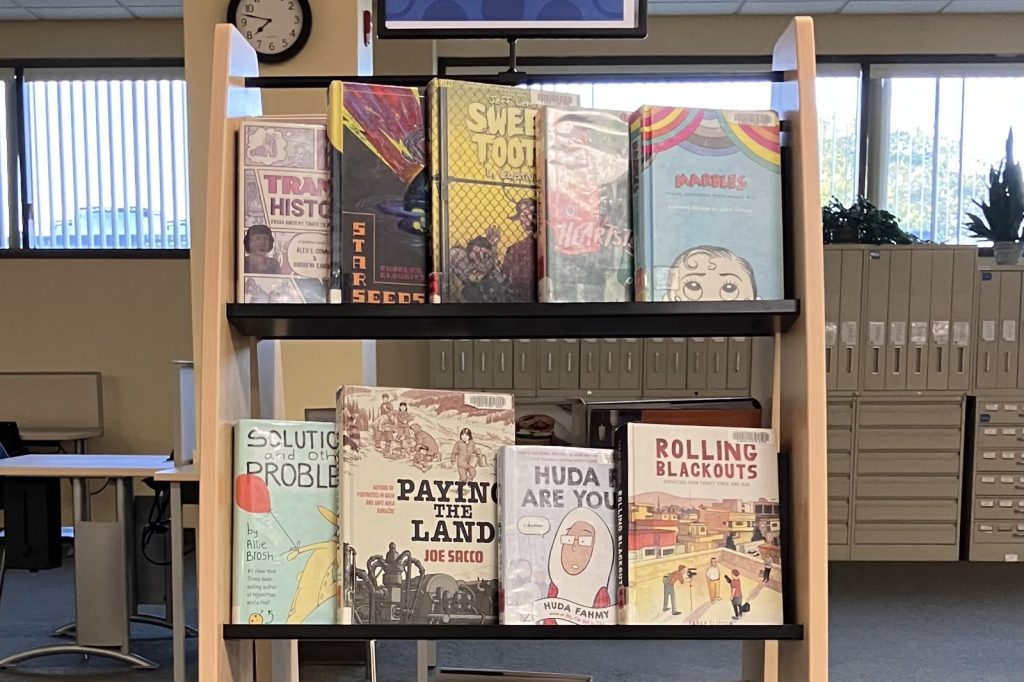
Graphic novels are now the third best-selling genre in North America, behind only general fiction and romance. They sit among the most popular titles in elementary-school libraries, win Pulitzer Prizes and National Book Awards, and get adapted into movies and streaming shows.
The nonfiction side of that boom is newer than the sales suggest. And this month it lost one of its pioneers: Marjane Satrapi, creator of “Persepolis,” died earlier in June. Her 2003 memoir of growing up in Iran during and after the 1979 revolution was one of the genre’s first blockbuster hits, and one of the most widely read and widely challenged graphic novels of all time. This year “Persepolis” became a story itself, in “Wake Now in the Fire,” an account of an attempt to pull the book from Chicago public schools and the student uprising that followed.
With that much on the shelves, nobody can read it all. Five books from the first half of 2026 stand out.
Anxietyland, by Gemma Correll
Correll is a British comic artist whose work has appeared everywhere from The New Yorker to tote bags reading “Pugs Not Drugs.” Her 2018 was rough. Days once full of project deadlines broke apart into insomnia, panic attacks and heavy drinking, and she eventually checked herself into a hospital.
The book casts life with anxiety as a theme park, with rides such as the Emotional Rollercoaster, the Worry-Go-Round and Hangxiety Falls. It runs 400 pages and uses two colors, blue for the past and red for her way out, which came through outpatient talk therapy, mental health walks and two needy pugs.
Emotional Support Animals, by Georges
Georges, known for “Calling Dr. Laura: A Graphic Memoir” and “Fetch: How a Bad Dog Brought Me Home,” drops her own beehived self-portrait here. Instead, well-dressed animals pass on lessons from her years of therapy. A beagle in a bandana says disappointing someone is not the same as hurting them. A cat in a green suit says you forgive because you need peace, not because the other person deserves it.
It began as a daily exercise: draw a favorite animal and let it deliver one insight. Ten chapters, including “Boundaries,” “Grief” and “Self-Worth,” come with worksheets based on the ones she drew for herself during pandemic isolation.
The End of the Arab of the Future, by Riad Sattouf
Sattouf’s series has six volumes in French, and English publication stalled after the original publisher dropped it. Fantagraphics repackaged the last two books, and the first of them came out last month. Volume 4 ended with his Syrian father and French mother separating, and his father taking the family’s savings and Sattouf’s baby brother, Fadi, to Syria. The new book follows his mother’s fight to get Fadi home, and Sattouf’s own adolescence in the early 1990s, with crushes, strange art and Nirvana’s “Nevermind” on repeat.
Bad Kid, by Sofia Szamosi
Szamosi was 13 the first time she was sent to a troubled-teen facility and 16 the second. The book renders those places in black, white and red. “Eat. Sleep. Pretend to be fixed. Repeat,” reads one panel. It closes on a line she earned: “We are all so much more than what we’ve done.”
Bury Me Already, by Julia Wertz
Wertz has drawn her life in comics for two decades, from “The Fart Party” to the Eisner-nominated “Drinking at the Movies” and “The Infinite Wait.” This collection covers a cross-country move, a pregnancy and a pandemic. Her diary comics of stick-figure Wertz and her son, Felix, capture a newborn’s first year: nursing, diaper changes, sleep and the sudden bolt awake. Told in a recent interview that her work is now just about having a kid, she answered: “Of course it is. I just birthed a human being.”