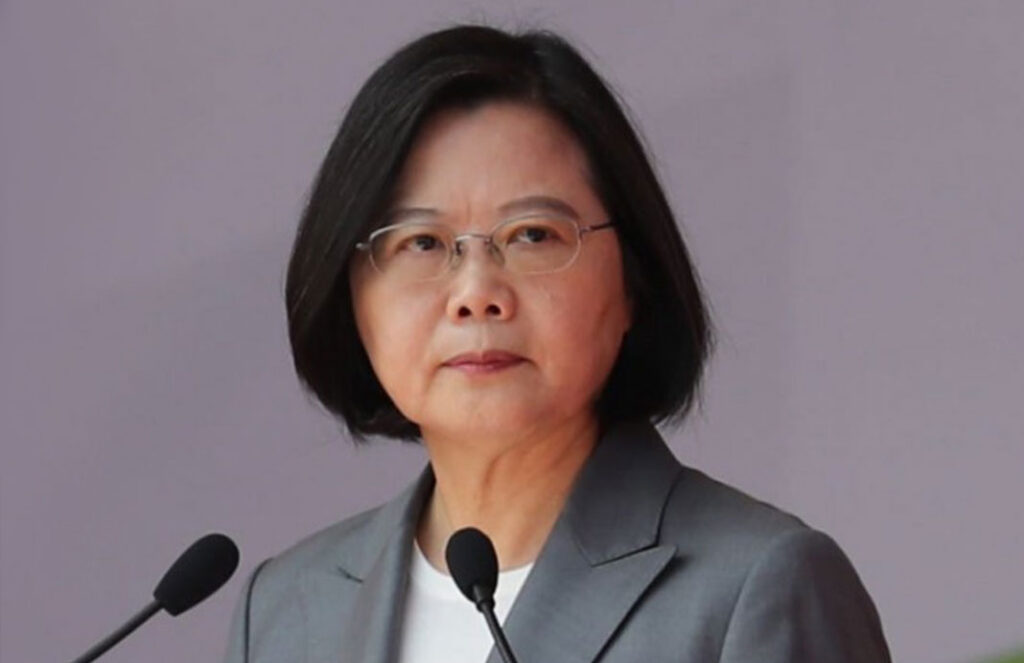
In an exclusive interview with the BBC, Taiwan’s President Tsai Ing-wen said that China needs to accept the fact that her country has long been sovereign. “We’re a successful democracy, we have a pretty decent economy, we deserve respect from China.” The re-elected President claimed a landslide victory in the recent race because of her tough stance against China.
Firmly supporting the “One China” principle, the Chinese Communist Party claims that Taiwan must be reunited with them, forcibly if necessary.
But the Taiwanese leader reiterated that her win serves as proof that this concept, which was considered useful, is no longer acceptable.
The self-governing island’s interests, according to her, will be served best by facing the reality and not by semantics.
“Invading Taiwan is something that is going to be very costly for China,” Tsai added.
According to reports, the “One China” the policy could be attributed to the vanquished patriots in the Chinese civil war who fled to Taiwan and kept on considering the island as an inalienable part of a greater China.
“We are an independent country already and we call ourselves the Republic of China, Taiwan.”
For the past years, Tsai had incessantly shown friendly gestures with China by expressing her willingness to talk to Beijing, but these initiatives only got refused, reports said.
The President furthered that her administration strives to boost Taiwan’s investment status by encouraging Taiwanese businessmen who created firms in China to return back to their island. The relationship between Taiwan and China is complex and has been a subject of debate for decades.
The two entities have a shared history, but their political paths diverged after the Chinese civil war, resulting in distinct systems of government. Taiwan has developed a democratic system, while China is governed by the Chinese Communist Party. This divergence has led to differing views on their relationship, with China considering Taiwan a part of its territory and Taiwan seeking recognition as a sovereign state.
The concept of “One China” has been a cornerstone of China’s policy towards Taiwan, emphasizing the idea that there is only one Chinese state and that Taiwan is an integral part of it. However, this principle has been met with resistance from Taiwan, which has developed its own identity and institutions. The Taiwanese government has sought to engage with China through diplomatic and economic channels, but these efforts have been hindered by China’s insistence on the “One China” principle.
As a result, tensions between the two entities have persisted, with periodic escalations in rhetoric and military posturing. The international community has also been involved in the Taiwan-China dynamic, with various countries taking different approaches to the issue.
Some nations have officially recognized China’s “One China” policy, while others have maintained diplomatic relations with Taiwan or supported its participation in international organizations. The United States, in particular, has played a significant role in the region, providing military and economic support to Taiwan while also seeking to maintain a stable relationship with China. The complex interplay of interests and alliances in the region has contributed to the ongoing tensions between Taiwan and China.
The significance of Taiwan’s sovereignty claim extends beyond the island itself, as it has implications for regional security and the global balance of power. The Taiwan Strait, which separates Taiwan from China, is a critical waterway for international trade and commerce, and any conflict in the region could have far-reaching consequences.
Furthermore, the issue of Taiwan’s status has become a focal point in the broader competition between China and other major powers, including the United States. As a result, the statements and actions of Taiwan’s leaders, such as President Tsai Ing-wen, are closely watched by governments and analysts around the world, as they seek to understand the evolving dynamics of the region and their potential impact on global affairs.