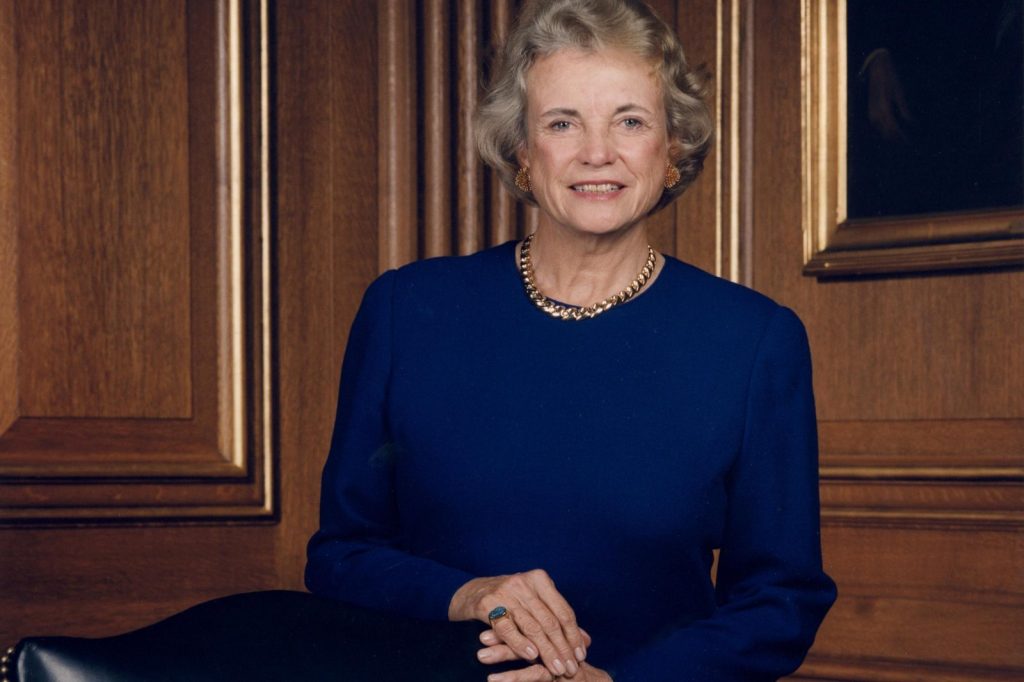
Sandra Day O’Connor called herself an “Arizona cowgirl.” She died Friday in Phoenix at 93, the first woman to serve as a Supreme Court justice. The Supreme Court said the cause was complications of advanced dementia, probably Alzheimer’s disease, and a respiratory illness.
Chief Justice John Roberts said she “blazed a historic trail as our Nation’s first female Justice.” He called her “a fiercely independent defender of the rule of law, and an eloquent advocate for civics education.”
President Ronald Reagan nominated her in 1981. She served 24 years before stepping down to care for her husband, who also had Alzheimer’s. On abortion, affirmative action and religion, hers was often the deciding vote. She wrote 645 opinions, many of them narrow and practical, and sometimes to the disappointment of conservatives. “You want to write narrowly so that you don’t decide too much in that one situation,” she told the Harvard Business Review.
Her successor, Justice Samuel Alito, was confirmed in 2006 and the court moved right, a shift that quickened with Trump’s three appointees: Neil Gorsuch, Brett Kavanaugh and Amy Coney Barrett. In the 17 years after her retirement, the court overturned some of her best-known decisions.
The Lazy B
O’Connor was the oldest of three children of Harry and Ada Mae Day. She grew up on the family’s Lazy B Ranch, which straddled the Arizona and New Mexico border and covered about 250 square miles. Rain fell 10 inches a year or less. The land was rocky, and coyotes, bobcats and rattlesnakes lived on it. “It was no country for sissies, then or now,” she wrote in “Lazy B,” her 2002 memoir with her brother Alan Day.
One summer before her senior year of high school, she got a flat tire driving the ranch pickup to a round-up crew two and a half hours away. Changing it alone in the sun took over an hour. She was late with lunch, and her father told her she “should have started earlier.” She said she hadn’t expected a flat. “Expect anything out here,” he replied.
The ranch was so remote that her parents sent her to live with her grandparents in El Paso, Texas, for school.
Stanford and a closed door
She enrolled at Stanford in September 1946 at 16 and started law school in her senior year, one of only four women in her class. She made the law review. With her partner, William Rehnquist, she finished as runner-up in the moot court competition. Rehnquist later became chief justice. They dated for a time, until she ended it in December 1950. She married John O’Connor, another law student, in December 1952 at the Lazy B.
Despite her top marks, no law firm would hire her. One California firm, Gibson Dunn, offered her a job as a legal secretary. She took a San Mateo County government post instead and agreed to work for free until the office found money for her. In 1954 she moved to Germany with her husband, an Army lawyer, and worked as a civilian lawyer for the Army Quartermaster Corps. Back in the United States in 1957, she hung a shingle at a Phoenix shopping center with another young lawyer.
The O’Connors had three sons. Balancing work and family was “desperately hard,” she later said. After her second child, she lost her babysitter and could not find another. For five years she pieced together legal jobs, from grading bar exams to bankruptcy appointments, while doing volunteer work and getting involved in Arizona Republican politics.
Up through Arizona
In 1965 she went back to full-time work as an assistant state attorney general. She was appointed to the Arizona State Senate after the incumbent stepped down, then won the seat in 1970 and again in 1972. That year she became Republican majority leader, the first woman in the country to hold such a post. She won a trial judgeship in Maricopa County in 1974, and in 1979 Gov. Bruce Babbitt, a Democrat, appointed her to the Arizona Court of Appeals.
Reagan had promised during the 1980 campaign to name a woman to the high court. When Justice Potter Stewart announced his retirement in June 1981, O’Connor was a little-known judge, not an obvious pick. But few conservative women were judges, and she had a friend in Chief Justice Warren Burger. Reagan, after meeting her, was impressed. He said he was “completely satisfied” with her “right-to-life position.”
Her three-day confirmation hearing opened Sept. 9, 1981, the first televised hearing for a Supreme Court nominee. The Senate confirmed her 99-0.