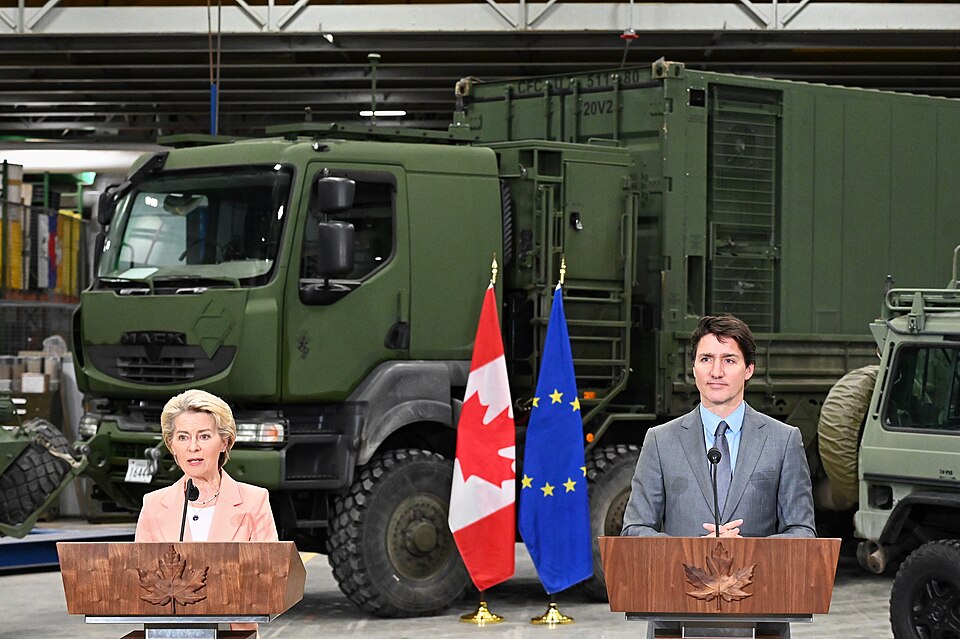
Ursula von der Leyen turned to Mark Carney in the chamber and made an offer. In her State of the European Union address on Wednesday, the European Commission president said she wanted to work with the Canadian prime minister on “opening the door for Canada to be the first associate member of the EU.” Canada and the bloc, she said, should move past their free trade agreement, CETA, and build an “Alliance for the Future.” Roberta Metsola, president of the European Parliament, went further at once and floated Australia and New Zealand as possible followers.
Donald Trump answered fast. He called the idea “laughable” and Canada a “terrible trade partner.” If he judged the arrangement a “hostile act,” he said, he would hit Europe with severe new tariffs or even stop trade in some areas. The same day he signed a memorandum telling his officials to find Canadian goods that could be shut out of the $280 billion US federal civilian procurement market.
Carney did not blink. Addressing the European Parliament on Thursday morning, he welcomed the offer and said polling showed an overwhelming majority of Canadians wanted much closer ties with Europe. Asked about Trump’s threats, he said a stronger, more sovereign Canada would be a better partner for the United States. Then his tone hardened: “Canadians are united that nobody is going to tell us what language we speak, no one is going to dictate our culture, or with whom we can strike agreements internationally.”
Not everyone in Brussels is pleased
Trump was not the only unhappy party. Several EU governments were reportedly furious that nobody had consulted them, and Germany, usually a friend of closer ties with Ottawa, publicly suggested rethinking the phrase “associate member.”
What would it mean in practice? Nobody quite knows, Brussels insiders included. The EU treaties have no such category. Article 49 of the Treaty on European Union lets only a “European State” apply to join, without saying what that is. And Canada is not applying. In Strasbourg, Carney said it is neither seeking nor able to become a full member, and that the substance of the relationship matters more than its label.
What it would build on
A good deal already exists. CETA has applied provisionally since 2017, though ten member states have yet to ratify it. Canada has been associated with Horizon Europe, the EU’s flagship research program, since 2024. At their June 2025 summit in Brussels the two sides signed a Security and Defense Partnership and launched a Strategic Partnership of the Future. Last February, on the margins of the Munich Security Conference, Canada became the first non-European country to join SAFE, the EU’s €150 billion joint defense procurement instrument.
Carney’s wish list went well beyond that. He wanted deep cooperation on critical minerals and their processing, defense industry, artificial intelligence and computing power, energy security, space and payment systems. He added seamless digital trade in non-agricultural goods, a wide range of services, and an integrated market for financial services. He also asked for more freedom for young Canadians and Europeans to live, work and study across the Atlantic, with Canada joining the next generation of Horizon and the Erasmus+ student exchange. Metsola has pointed to common rules on social media and the protection of minors.
Put together, Canada would sit inside much of the EU’s economic, technological and educational world while staying out of its political institutions. No Canadian commissioner, no Canadian members of the European Parliament, no seat at the European Council table.
The short answer is Trump
About 70 percent of Canada’s exports still go to the United States, down from more than three-quarters before the US-Canada trade war. That integration built Canadian prosperity for decades. It is now seen increasingly as a weakness. Carney wants enough alternative markets, suppliers and political partners that no country, the United States included, can use trade dependence to push Canada around. Europe has reached a similar view. It leans on the United States for security and technology, on China for critical raw materials and manufacturing, and until recently on Russia for energy.
In Strasbourg, Carney told of a Canadian lieutenant who gathered acorns at Vimy Ridge in World War I and planted them in Ontario; a century later their descendants have been replanted on the same French ridge. The image served a harder argument. “Economic integration is now being weaponized,” he warned, “and tariffs are being used as a means of pressure.” Trade coercion, climate change and eroding democratic norms made, in his words, “a ferocious storm.” In such a storm, he said, “a single tree will come down in it [while] a forest will not.”
How seriously to take the threats
Trump now has a legal tool. This week the House gave final passage to the Lindsey O. Graham Sanctioning Russia and Iran Act, named for the late senator and passed by the Senate in August, which Trump is expected to sign. It lets the president impose tariffs of up to 100 percent on the biggest buyers of Russian oil and natural gas. China and India are the main targets, but critics warn that broad wording and generous waivers could pull in European countries, since Europe was long Russia’s largest gas customer.
The irony is plain. American pressure is the main reason Ottawa and Brussels want less dependence on Washington, and each new threat strengthens the case. Yet it could also make the project harder. Several EU governments were wary of provoking Trump before von der Leyen spoke, and any ambitious deal with Canada needs their unanimous blessing. The Commission president may have run ahead of European politics.
A new outer circle?
Metsola clearly thinks others could follow. For three decades the EU has sorted the world into full members, candidates and outsiders with varying access to the single market, and that is a poor fit now. The United Kingdom left but remains tied to Europe’s economy and, through NATO, its security. Ukraine wants in but may need many more years. When German Chancellor Friedrich Merz floated “associate membership” for Kyiv last May, Brussels was lukewarm at best, which makes the Canadian offer more striking.
Canada, Australia and New Zealand could not join under the current treaties, yet they share most of Europe’s strategic interests and values. Associate membership could create an outer ring of countries opting into parts of the EU system, such as research and education, defense procurement and technology standards, in return for following the rules and paying into the budget where appropriate.
London may wince. Brexit was partly sold on the complaint that the EU offered nothing between full membership and the exit door. More than six years after the UK left the EU’s institutions on January 31, 2020, Brussels is weighing exactly that middle category, and for Canada, a country that still has a British monarch as head of state.
The obstacles are real. Several member states have long resisted a Europe à la carte, fearing outsiders could enjoy the benefits of membership without its duties. Candidates from the Western Balkans to Ukraine can fairly ask why Canada should get privileged access while they grind through painful reforms. And if ten states still have not ratified CETA after nine years, a far bigger deal looks hard indeed.
Canada has its own limits. It is deeply tied into the North American economy and probably has no appetite to become a giant Norway, following EU rules without a vote. Carney framed the alliance as a way to strengthen Canadian sovereignty and collective resilience, and insisted he was not proposing a “third bloc in order to become a great power rival—only with better manners.”