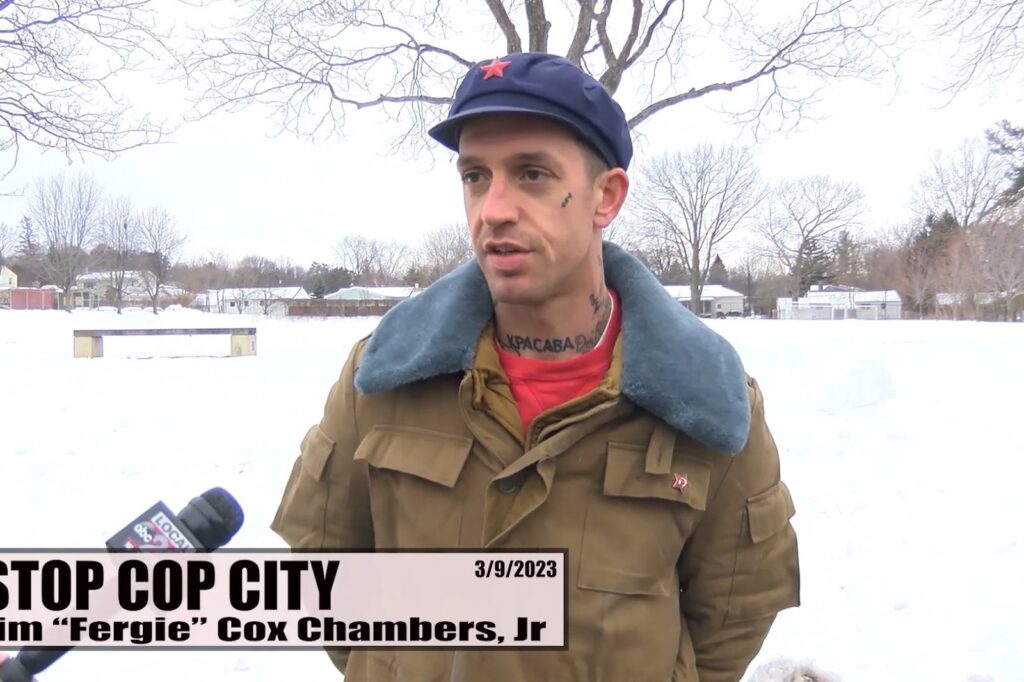
On 10 July, Spanish National Police arrested James “Fergie” Chambers Jr. in the street in Ibiza, where he was with family members. The Cox Enterprises heir, an American communist activist born around 1985, was held on a sealed extradition request from the United States Department of Justice. Three months on, he is in a Madrid prison, and his case has become a test of how far anti-terror law can reach into humanitarian giving.
Against this backdrop sits a film. “All About the Money,” directed by the Irish filmmaker Sinéad O’Shea, premiered in the World Cinema Documentary Competition at Sundance on 25 January 2026. O’Shea began developing it with Screen Ireland in late 2022 and filmed intermittently from June 2023 to November 2025. It follows Chambers from the founding of his commune in Massachusetts through a November 2023 protest at the Elbit Systems office in Merrimack, New Hampshire, then to Tunisia, where he bought the football club Club Africain, and finally to Ireland. The real story outran the edit.
The money and the charges
Chambers separated from the family company in 2023. The Guardian reports that he sold stock back worth about $250 million, as part of a settlement in which the family severed ties. Since then, according to his partner, the actor and activist Stella Schnabel, he has funded an estimated 100 projects in 20 countries. His giving includes more than $1 million to humanitarian causes in Gaza, among them the Sameer Project, and legal fees for members of Palestine Action.
The indictment remains sealed. The Guardian says the extradition request ties him to alleged financial support for Hamas and also covers charges linked to the Elbit protest; Elbit is an Israeli weapons manufacturer. Chambers is said to face several federal charges carrying up to 30 years in prison. His family disputes the Hamas allegation, saying it stems solely from $7.5 million of his own money that he moved from the United States to Tunisia, where he was living.
Stanley Cohen, an American attorney with four decades in terrorism cases, called the case politically motivated and the first known instance of the United States seeking to extradite a citizen over alleged support for Hamas. The author Trevor Aaronson compared it to the Holy Land Foundation prosecutions of the mid-2000s and warned of a “chilling effect” on charitable giving to Palestinian causes.
In the corridors of the Spanish courts
Audiencia Nacional judge Antonio Piña ordered Chambers held without bail on 11 July. A later request for provisional release was refused, in part because his wealth made him a flight risk, the Guardian reports. On 18 September, around 150 artists, activists and academics, among them Richard Gere, Cynthia Nixon, Angela Davis and Greta Thunberg, signed a letter urging Madrid to reject the extradition.
Four days later, on 22 September, the Council of Ministers declined to block the request. The decision did not settle whether Chambers will be handed over; it only let the process continue in Spanish courts, which will decide. Elma Saiz, the minister of inclusion, social security and migration, called the step “purely procedural.”
Chambers’s legal team, which includes several prominent human rights lawyers, plans to argue that extradition is politically motivated and would breach the political offense exception in the treaty between the two countries. Sumar, the junior partner in Pedro Sánchez’s government, and a number of Spanish parliamentarians oppose the move. Irene Montero of Podemos said the Spanish government should protect him. In the Dáil, People Before Profit TD Paul Murphy pointed to the “long reach” of United States foreign policy, while Taoiseach Micheál Martin said he expected Spain to take a “fair and honourable” approach.
Chambers has also applied for political asylum from prison. Under Spanish law an asylum applicant cannot be extradited until that process ends.
The missing phone
A new dispute concerns his cellphone. His lawyer Aitor Martínez told the Guardian that when the team asked about it on a Tuesday, they learned it was no longer held by the national court and had gone to the FBI. The court had given written assurances that it would stay in its custody while the extradition was resolved. “I’ve never seen anything like this in an extradition case,” Martínez said.
The defense has petitioned an appeals court for the phone’s return, a full chain-of-custody account, and an answer on whether the United States has opened it. Martínez noted that the 1970 treaty allows a person’s possessions to be released to the requesting country only once extradition has been granted. Schnabel said she was not surprised, calling it “exactly in line with this administration not following the rules of the legal system.”
The Spanish courts could take months to rule.
Sources
- Fergie Chambers
- US seized American heir’s cellphone in violation of treaty agreement, lawyer says
- Trump’s War on Palestine Comes for Fergie Chambers
Photo: Town Meeting TV (CC BY 3.0)