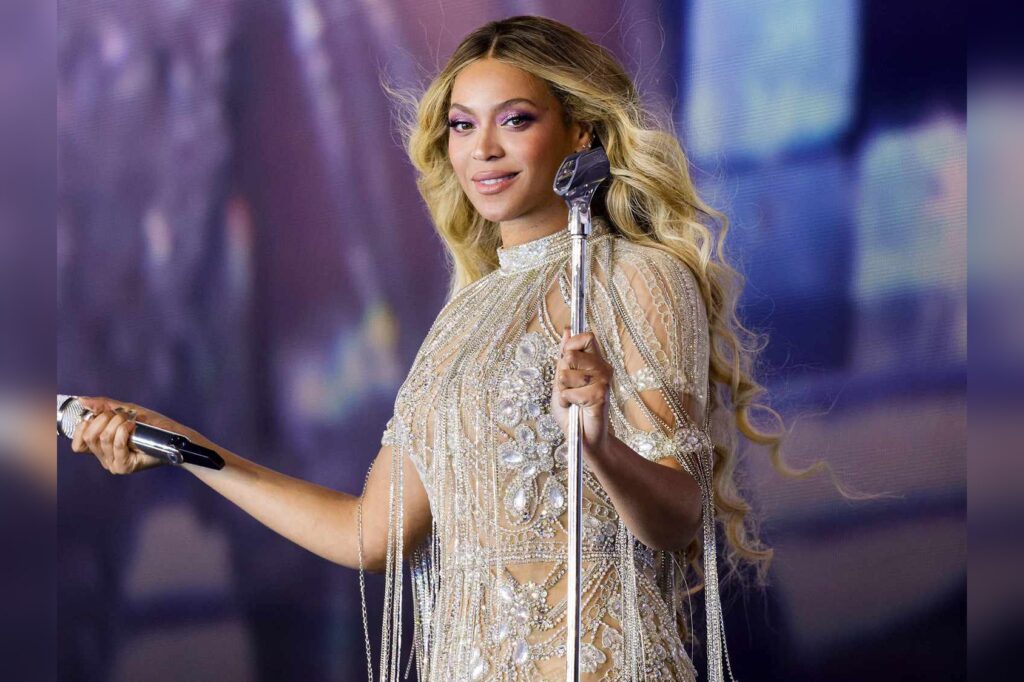
Before Beyoncé walks out, the screen shows a huge American flag. Then a geometric grid is laid over the stars and stripes, and a pyramid-shaped portal splits the flag down the middle for her and the performers to step through.
That was the opening of the Cowboy Carter tour at SoFi Stadium in Los Angeles, as described by a writer for Architectural Digest who watched from the venue’s VIP suite. The tour, officially called Cowboy Carter and the Rodeo Chitlin’ Circuit Tour, was booked for five nights at SoFi before moving on across the country.
A flag, a star and a few questions
The stage is shaped like a star, a nod to Texas, where the singer grew up. The reviewer called the show a “neon-lit Southern rodeo-meets-Hollywood Western extravaganza.” Small numbers sit in the corner of each square on the flag backdrop. The writer asked a fellow concertgoer, who guessed they were coordinates. Nothing confirmed that.
The night opens with the ballad “American Requiem,” with dancers moving in tight lines. Later, archival footage of Black female country singers and instrumentalists runs on either side of her while she sings “Blackbird.” During “Formation,” a scowl-smirk crosses her face on the line “but they never take the country out me.” The reviewer also noted an anthem sequence preceded by footage of her face behind a lace mask, with crows around it.
Western film interludes run between the acts. In one, a giant Beyoncé smokes a cigar next to the Statue of Liberty and strolls past Prada Marfa. In another she pistol-whips a woman in a saloon brawl and ends up preserved as a gold statue. The writer had mixed feelings about the cheaper stunts but judged that she succeeds in making clear her commitment to Southern culture and in reclaiming country’s Black roots on a global stage.
Her own back catalogue
This is no album-only tour. Parts of the staging recall the Renaissance tour, and hits sit beside the new songs. During “Thique” the stage turns into a beauty salon, like the set of the 1999 Destiny’s Child video for “Bills, Bills, Bills.”
The name carries a second reference. The Chitlin’ Circuit was a network of venues in the American South, East and Upper Midwest that gave Black artists a place to perform during segregation.
The show runs a full three hours. The pyrotechnics and lights drive the crowd, the reviewer wrote, and the star-shaped stage ends in an arrow aimed straight at the audience. “I couldn’t stop dancing and singing along,” the writer said.