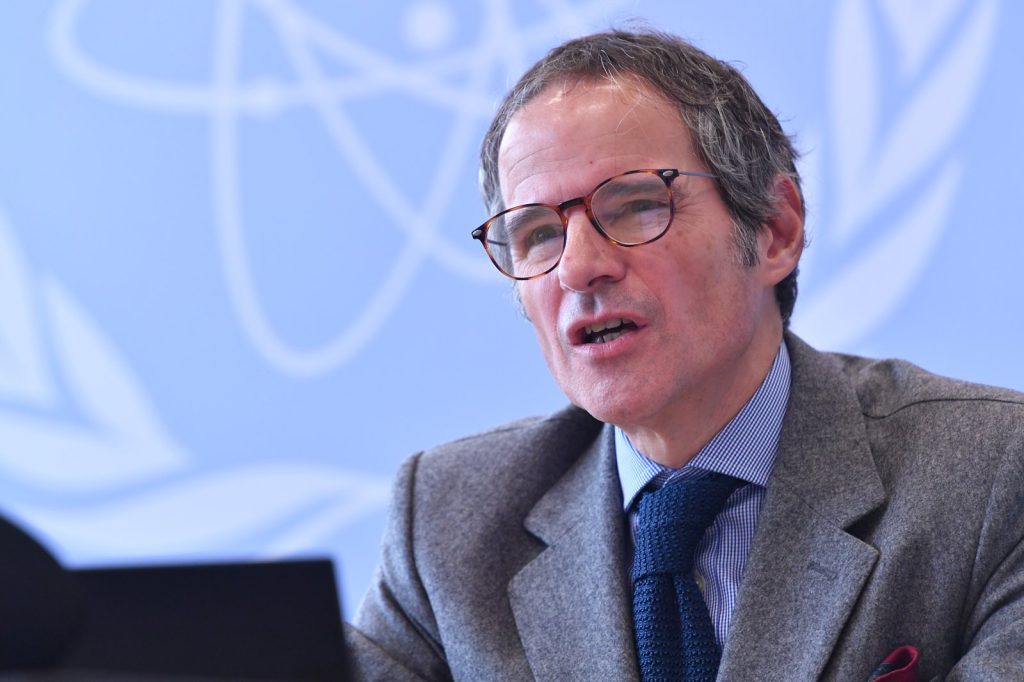
The flags going up at Ukraine’s nuclear power plants this week are not diplomatic ornaments. They mark a permanent, on-the-ground presence of International Atomic Energy Agency staff at every single one of the country’s active reactor sites. At least 11 agency employees are now stationed across Ukrainian nuclear facilities.
That number is small. The responsibility is enormous.
The expansion was announced on January 27 by IAEA Director General Rafael Grossi during a visit to Kyiv. He had already been on the move. On January 24 he was at Rivne.
The next day he traveled to Chernobyl. The installations and flag-raisings were done.
Ukrainian Prime Minister Denys Shmyhal stood with Grossi at a press conference and laid out the new reality plainly. “Starting the following day, there will be two flags at all of the nuclear facilities in Ukraine; one of Ukraine and the second of the international nuclear agency,” Shmyhal said. The Zaporizhzhia plant already had IAEA staff.
It is Europe’s largest nuclear station and it sits under Russian military control. The fighting around it has been a source of global alarm for months. Now the agency has pushed its footprint to the other three active plants — Rivne, Khmelnytskyi, and South Ukraine — plus the decommissioned Chernobyl site.
The goal is straightforward: reduce the risk of a catastrophic accident while the war grinds on near these facilities. Grossi said the personnel will remain at each site “as long as they are requested” by the Ukrainian government.
That is an open-ended commitment. It means the IAEA is effectively embedding itself into the wartime operations of a country’s entire nuclear fleet. This has never been done before.
The flags are meant to signal something real. Grossi said they “represent and they will signify the presence of some of the most well-known professionals in safety and security who will offer guidance and technical help to each site.” The agency is not just observing.
It is providing technical guidance and monitoring safety systems as the fighting continues. The mission is to confront specific challenges at each plant. The implications are heavy.
Every plant now has international witnesses. That changes the calculus for any party considering military action near a reactor. An attack or a shell that hits a containment structure would not just be a Ukrainian disaster.
It would be an incident with IAEA staff on site, reporting in real time. The agency’s presence creates a tripwire of accountability.
But it also creates a new set of dependencies. The Ukrainian grid is under constant strain from Russian strikes on power infrastructure. A nuclear plant that loses off-site power faces a crisis.
Having IAEA experts on the ground helps, but it does not stop missiles. The agency can offer guidance.
It cannot stop a war. Grossi’s travel schedule shows the urgency. He went from Chernobyl to Rivne to Kyiv in a matter of days.
The speed of the deployment suggests the agency has been planning this expansion for weeks, waiting for the right moment to announce it. The moment came as winter deepens and the fighting shows no sign of easing. The IAEA now has a permanent footprint at every Ukrainian nuclear site.
That footprint is small — 11 people spread across multiple facilities. But it is a presence that did not exist before the war.
It is a presence that the agency says will last as long as Ukraine asks for it. That could be years. That could be longer than the war itself.